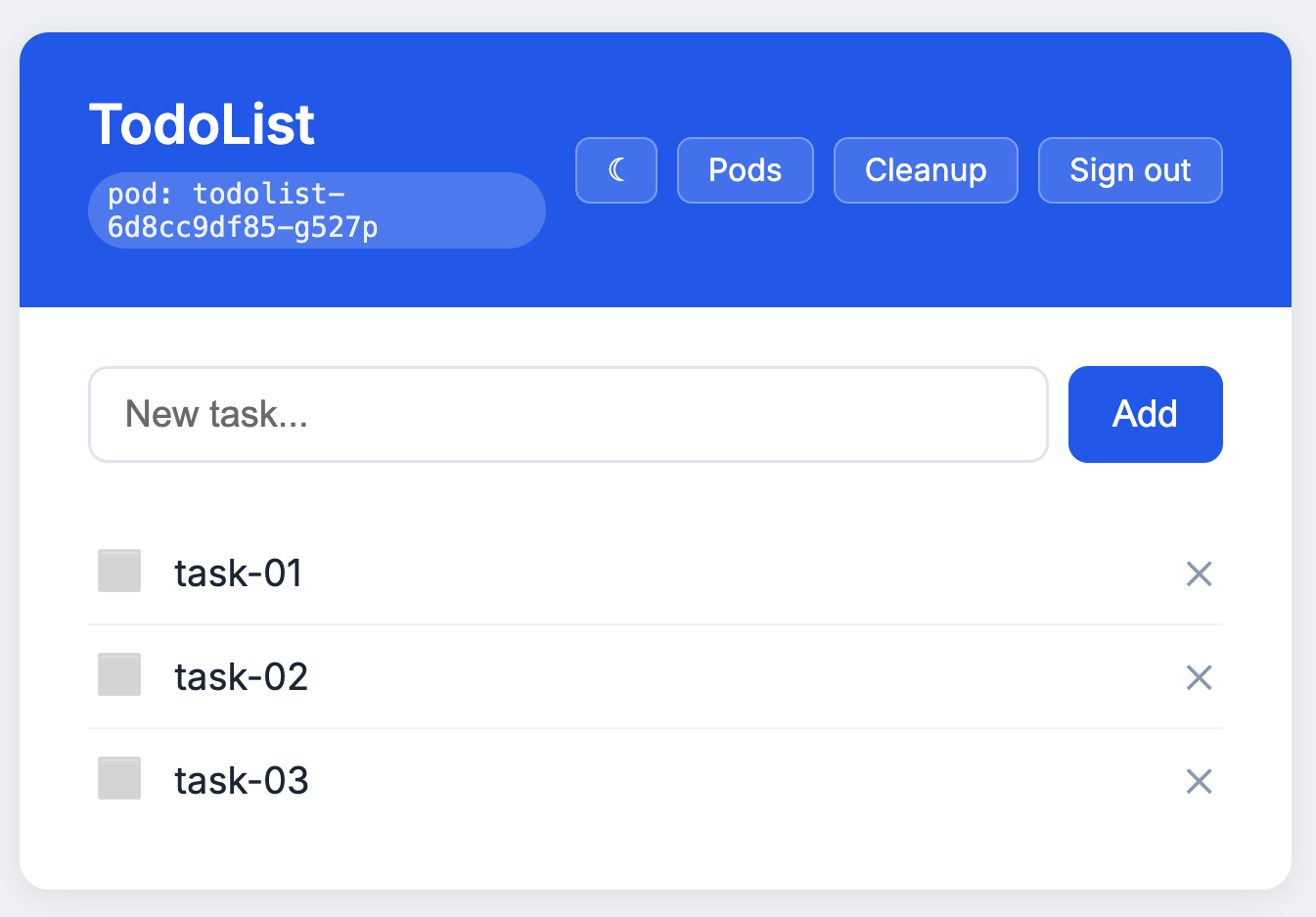
Use case: TodoList
This handbook exists because of one concrete problem: take a small web application to Kubernetes, the platform way. This page tells that story end to end — the brief, the framing, the path, and what was delivered. It is the "why" behind every other page.
The brief
A Platform Engineering team wants to talk about platform engineering from the code. The task:
- Provision the infrastructure and dependencies the application needs, automated.
- Deploy a new version of the application, automated.
- Sustain it: the application must be scalable and resilient.
- Document it so someone else can understand and operate it, including the decisions and what was discarded.
The application is a Flask + PostgreSQL todo list. Running it is trivial; the work is the path to production and the decisions along the way.
Framing: is a single app on Kubernetes the right shape?
A single small application on a Kubernetes cluster is arguably an anti-pattern — the cluster's control plane, networking, and add-ons cost more attention and money than the app. A serverless shape (Lambda + API Gateway + a managed database) fits one small service better.
But Kubernetes was a requirement, so the interesting question became: how do you run it as if it were one of many applications on a shared platform? That framing drives every decision here:
- A platform repository (the foundation) separate from the application repository.
- A contract between them, so an application never reads platform internals.
- One owner per resource, so the platform and the app never fight.
- A cost model and a budget, because the foundation is what actually costs money.
See Architecture and Ownership.
The path
1. Local first
The application runs on a k3d/k3s cluster from a single multi-stage Dockerfile and a single
Helm chart, with a Makefile and a beginner's guide. Local is a developer's loop, not a pipeline
stage — but it uses the same chart that runs in the cloud.
2. The platform
The AWS foundation is OpenTofu, split into reusable modules (VPC, EKS, Aurora, ECR, secrets,
ingress/DNS/TLS, runners, Argo CD) and environment roots (dev, then prod). State is remote,
encrypted, locked, and kept out of Git. A budget with alerts is part of the code.
3. Delivery
CI is GitHub Actions on self-hosted runners inside the VPC, using IRSA (no long-lived keys).
A merge to main builds the image, scans it with Trivy (failing on CRITICAL), pushes it to ECR by
digest, commits the digest, and smoke-tests the deployment.
4. GitOps
Argo CD owns the application release; CI never runs helm upgrade. The platform publishes
non-secret wiring through the contract (SSM), and the application's chart and per-environment digest
live in the application repository.
5. Production and promotion
A second environment (prod) demonstrates promotion: a published release promotes the same
dev-validated digest through an approval-gated job — no rebuild — and rollback is a digest change.
6. Documentation as a service
Because the project grew, the documentation became its own service: this handbook, delivered like any application (built in CI, served as a static site on S3 + CloudFront). Adding it exercised the platform's onboarding path end to end.
What was delivered
| Requirement | Where it lives |
|---|---|
| R1 — Provisioned by code | platform/ (OpenTofu), runbook |
| R2 — Automated deployment | GitHub Actions + Argo CD, pipeline |
| R3 — Browser access | Route 53 → ALB (ACM TLS) → Ingress, environments |
| R4 — Scalability & resilience | HPA + Cluster Autoscaler, PDB, rolling updates, runbook |
| R5 — Documentation & decisions | this handbook, decisions, costs |
Beyond the requirements: a second environment with promotion, GitOps, a hardening backlog, and a roadmap.
What we would do next
The honest gaps are in the roadmap: a single Argo CD across environments, observability, progressive delivery, policy/admission, and broader security gates. One design question is still open: whether an application should own its own infrastructure (database, queues) in its own repository — see the open discussion.
Links
- Application: https://github.com/artmiraws/todolist-app
- Platform: https://github.com/artmiraws/platform
- Handbook: https://github.com/artmiraws/platform-docs